Piekiełko on the Wel is one of the most distinctive and demanding river sections in northern Poland. If the calm, meandering Drwęca is not enough for you, and you already know the Brodnica Lakeland from the lakeside, this stretch of the Wel could be the next step in your kayaking adventure.
The following guide was prepared by Kajak CBR with the 2026 season in mind — for people who consciously seek stronger thrills but want to do so responsibly and safely.
What is the “Piekiełko” on the Wel?
“Piekiełko” is the colloquial name for an approximately 2‑kilometer stretch of the Wel River with an unusually fast current, located in the Górznieńsko‑Lidzbarski Landscape Park. On the map you will find it between the villages of Chełsty and Trzcin.
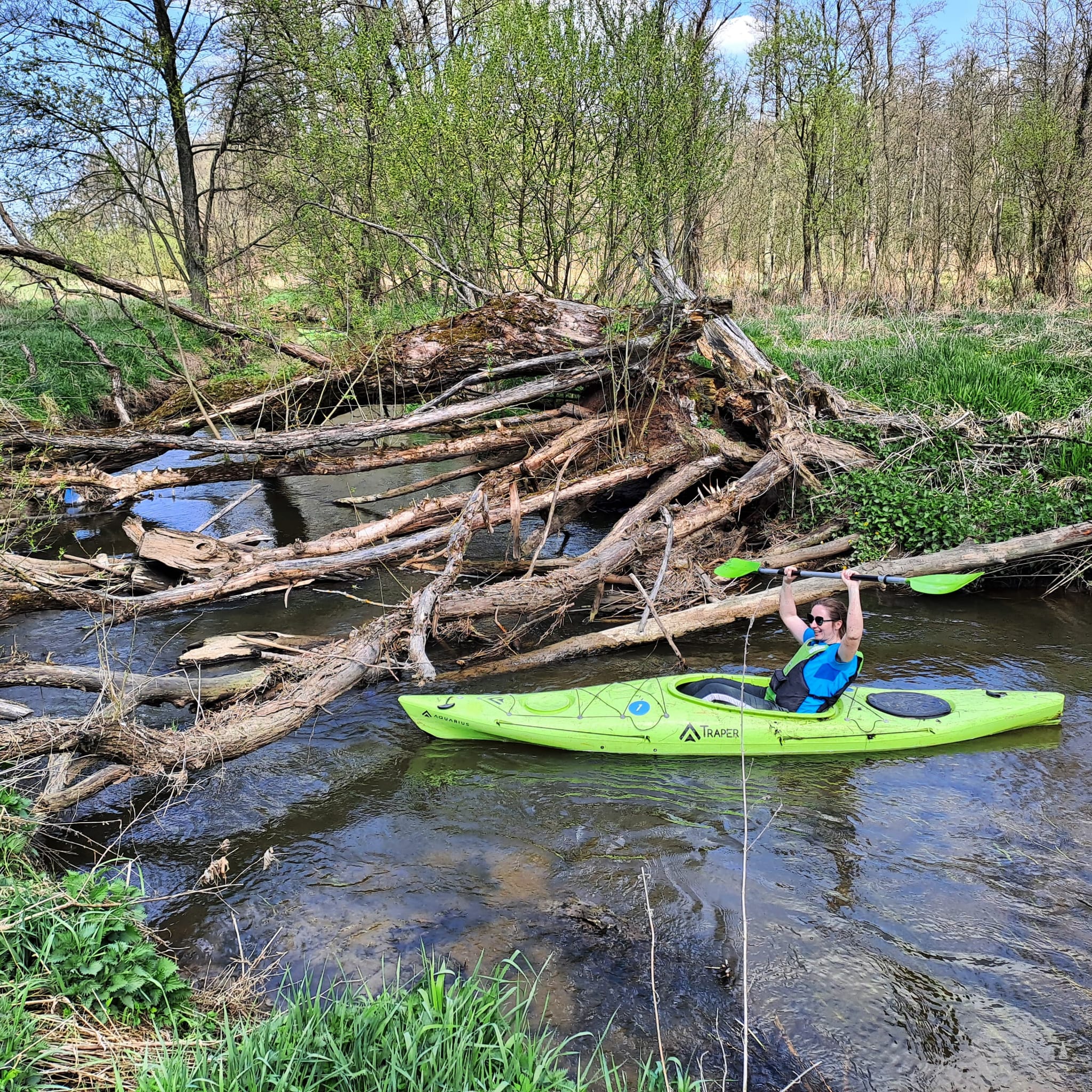
The Wel itself is a small, picturesque river — a right tributary of the Drwęca — but on this stretch it changes character: the current speeds up, numerous rapids appear, fallen trees, narrow choke points and tight bends. The sensation is closer to a mountain stream than a typical lowland river.
For many experienced paddlers “Piekiełko Wel kayaks” is synonymous with: - a bigger adrenaline dose, - intense paddling effort, - the necessity of good technique and concentration.
This is not a section “for the first time”, but for a properly prepared team it can be one of the most interesting challenges of the 2026 season.
Difficulty level and who should paddle
Who is the “Piekiełko” for?
We recommend the Chełsty–Trzcin section only for people who: - already have experience in paddling rivers with a livelier current (e.g. parts of the Drwęca with obstacles, other lowland rivers with rapids), - feel confident in a kayak – can keep direction, react to the current, and perform quick maneuvers, - are not afraid of contact with water – you must assume a real possibility of capsizing, - are in good physical condition – 2 km of intense paddling in a fast current can tire you more than 15–20 km of a calm river.
We do not recommend the “Piekiełko” for: - complete beginners, - families with small children, - people who are afraid of water or cannot swim, - groups aiming for a “picnic on the water” and loose drifting.
Minimum requirements for participants
Before paddling difficult stretches of the Wel it is worth honestly answering a few questions:
Have you already paddled a river with a noticeable current?
If your experience is limited to calm lakes — start with the Drwęca or easier sections of the Wel.Can you perform basic maneuvers?
- stopping the kayak at the shore,
- controlled turns to the right/left,
- paddling backward,
- avoiding obstacles (stones, branches, fallen trees).
Do you accept the risk of capsizing?
On the “Piekiełko” a capsize is not a failure but one of the possible scenarios. It is important to know how to behave then.
If you have doubts — contact us (Kajak CBR), describe your experience, and we will advise whether “paddling Wel difficult sections” is the right moment or if it is better to first get comfortable on the Drwęca or Skarlanka.
Equipment and technique — how to prepare the kayak and paddling in a fast current
What kayak for the “Piekiełko”?
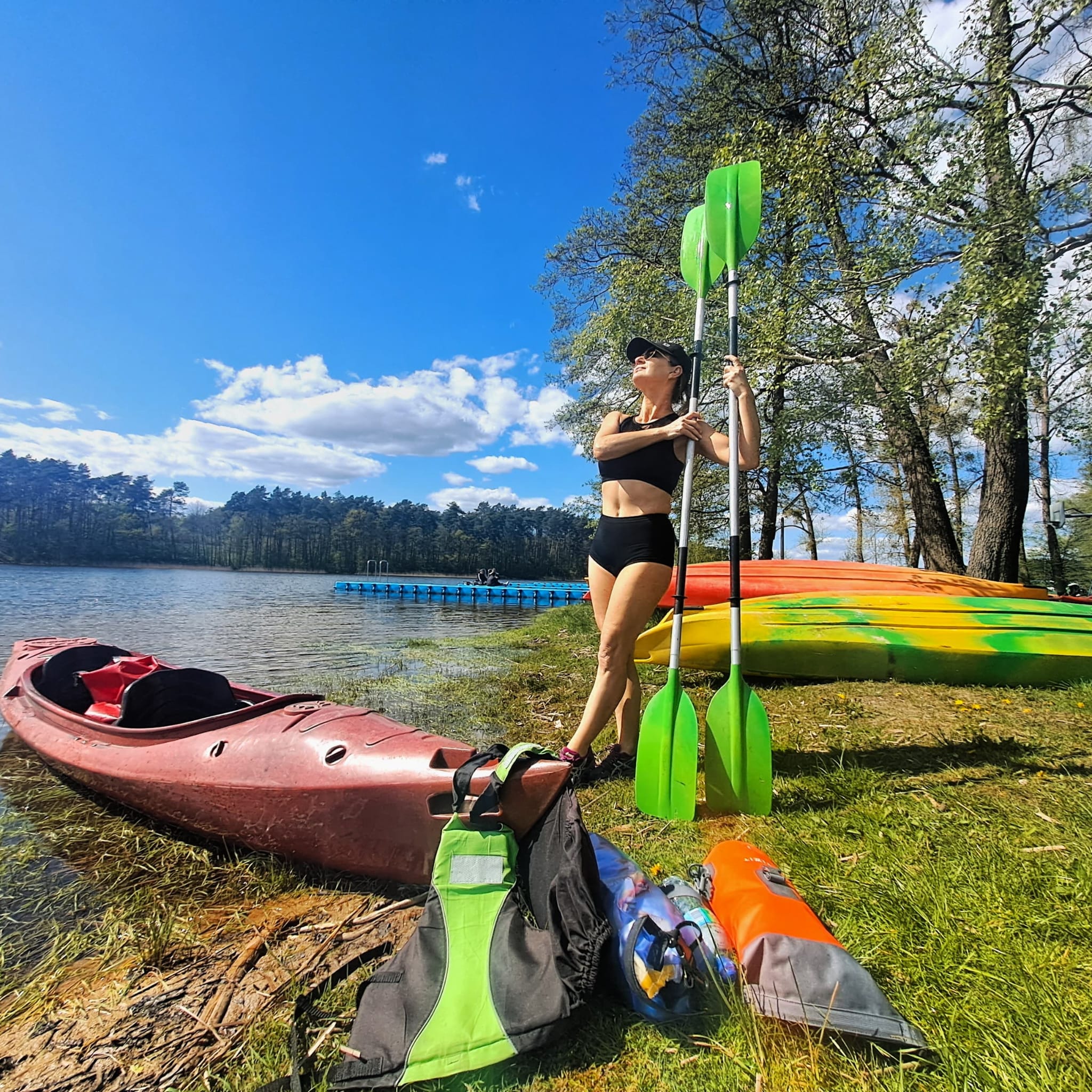
On the Wel we use proven polyethylene touring kayaks from our fleet: - Aquarius Pro Tour 470 – stable, a reliable "workhorse" for rivers and lakes, - BeKayaker Finder Active II – 2 + 1 (child), wide and durable, - Aquarius Traper – single, maneuverable touring kayak.
For the “Piekiełko” we recommend: - two-person kayaks for well-coordinated crews (the stern paddler at the back should have experience), - single kayaks for paddlers who are skilled alone and want more control.
We do not take the youngest children in add-on seats on this stretch — this is not a family route.
How to prepare equipment before entering the water
- Check the condition of the kayak — hulls, handles, footrests, seats. Report any concerns to us before the start.
- Adjust the footrests — in a fast current a solid foot brace is the foundation of kayak control.
- Secure luggage — everything that must stay dry should go in a waterproof bag (we provide 1 bag per kayak).
- Phone only in a waterproof case — preferably on a lanyard, hanging around the neck or attached to the vest.
- Life jacket on and fastened — not in the kayak, not under the seat.
Basics of technique in a fast current
On the “Piekiełko” three elements are particularly important:
Reading the water
- look a few meters ahead of the bow, not at the paddle,
- watch for “white water” (rapids), eddies behind obstacles, fallen trees,
- plan your line of passage in advance.
Work of the whole crew (in a two-person kayak)
- stern paddler at the back – decides on direction, gives commands ("right harder", "left stop", "we back"),
- bow paddler – the kayak’s “engine” and “eyes”, points out obstacles, reacts quickly to commands.
Maintaining speed
In a fast current do not brake unnecessarily. A kayak that has speed close to the current is more stable and easier to steer around obstacles. We stop only in safe spots (bays, eddies, wide sections of the river).
If you want to refresh your technique, before the 2026 season visit technique guides (e.g. kayakpaddling.net) and consider a short training with our instructor.
Safety — belaying, lifeguard, procedures in case of failure
Safety rules applicable on the Wel
All Kajak CBR regulations apply on the “Piekiełko”, but a few have special importance:
- Absolute ban on alcohol and other substances — people under the influence do not enter the water. This is not only a rule but real safety in a difficult current.
- Life jacket mandatory throughout the trip — do not remove it even "for a moment".
- We paddle in a tight group — so that in case of a capsize help is within a few–dozen seconds.
- We respect nature — do not litter, do not make excessive noise, remember we are in a landscape park.
Belaying and the role of the lifeguard
For trips on the more difficult sections of the Wel we recommend: - the presence of a WOPR lifeguard — cost 500 zł/dzień (1 lifeguard for up to 15 participants), - or a kayaking instructor/guide — 400 zł/dzień.
In practice, for larger groups (especially corporate, school, integration events) the optimal solution is a combination of both functions: a lifeguard + an experienced guide on the water.
What to do in case of a capsize?
- Keep calm — this is key.
- Do not try to stand up forcefully in the current — you may get stuck in mud or hook your leg on an obstacle.
- Hold on to the kayak or paddle — if it is safe. The kayak is buoyant and easier to recover later.
- When drifting with the current, keep your legs in front of you (on the surface) to absorb possible impacts with obstacles.
- Make your way to the shore at a safe spot — don’t fight the current unnecessarily; use it to reach a calmer section.
After getting ashore: - check that everyone from your crew is safe, - assess the condition of the equipment, - if necessary — contact us by phone.
Storm, sudden weather change, other emergency situations
According to the Kajak CBR regulations: - in case of a storm or other phenomena preventing further paddling we immediately stop the trip, - we get ashore in a safe spot (away from single, tall trees), - we contact the rental — we will arrange further steps and possible pickup.
How to organize a “Piekiełko” trip with Kajak CBR
Why only for larger groups?
The Wel is about 25 km from our main operating area (Brodnica Lakeland, Drwęca). Transporting kayaks and people to this stretch is more time-consuming and costly, therefore: - we organize Wel trips only for larger groups, - each order is priced individually — we take into account the number of kayaks, route length, scope of services (lifeguard, guide, accommodation).
If you plan the “Piekiełko Wel kayaks” as the main attraction of a corporate trip, integration or a friends’ outing — contact us in advance.
What we can organize for you
As part of comprehensive service for a Wel trip we can provide: - kayak rental (1-, 2- and 3‑person), - equipment transport – 4 zł/km (bus + trailer, up to 15 kayaks per run), - participant transport – the bus carries up to 8 people without additional charge, - WOPR lifeguard – 500 zł/dzień, - instructor/guide – 400 zł/dzień, - organizational support – coordination of start, finish, times, and possible portages.
Additionally you can combine the “Piekiełko” with: - a trip on the Drwęca (e.g. from Bratian downstream), - overnight camping at the “Miejscówka Kupno” campsite on the Drwęca, - a multi-day trip combining the Wel, the Drwęca and the lakes of the Brodnica Lakeland.
How to reserve a date for 2026
- Go to kajakcbr.pl/kontakt.
- Write or call (tel. 500 159 361) with the information:
- planned date (or date range) in 2026,
- number of people and approximate number of kayaks,
- whether you are interested in a lifeguard / guide, accommodation, additional attractions,
- whether the group already has experience on more difficult rivers.
- We will prepare an individual quote and propose a concrete trip scenario.
Best time to paddle and hydrological conditions in 2026
When is the “Piekiełko” most interesting?
The character of the Wel strongly depends on the water level. In practice: - spring (April–May) – higher water levels after snowmelt and rains; the current is faster, some obstacles are submerged, but the rapids are stronger, - early summer (June) – usually an optimal combination of water level and temperature; often the best time for a “paddling Wel difficult sections”, - late summer (July–August) – after prolonged drought the water level may drop, which means more stones, shallows and the need for more frequent maneuvers or short portages, - autumn (September–October) – fewer people on the water, beautiful forest colors, but colder water and air – requires better clothing.
For the 2026 season we assume a similar pattern, but each time before the trip we check current hydrological conditions and weather forecasts. With too low or too high water levels we may:
- suggest a date change,
- shorten or modify the route,
- in extreme cases – discourage the “Piekiełko” trip and offer an alternative (e.g. the Drwęca).
How to dress and prepare for 2026
Regardless of the season, on the Wel it is worth bringing: - sport, quick‑drying clothing (synthetics instead of cotton), - water shoes or sandals – avoid heavy, lace-up shoes, - a spare set of clothes in a waterproof bag, - a rain jacket or a light poncho, - a cap / hat with a brim and sunscreen, - cycling gloves – during intensive paddling they protect hands from blisters.
Also remember: - drinking water and light provisions, - mosquito and tick repellent, - a small first aid kit (basic medicines, plaster, bandage).
If you feel that calm lakes and the gentle Drwęca are no longer enough, and at the same time you want to step up your kayaking adventure in controlled conditions — the “Piekiełko” on the Wel can be your challenge for the 2026 season.
Contact us via kajakcbr.pl/kontakt or by phone (500 159 361), tell us about your crew and experience. We will help plan a safe, well-organized trip on one of the most exciting stretches in the Górznieńsko‑Lidzbarski Landscape Park.